
Ventilation plays a quiet but important role in industrial and commercial spaces. You may not notice it when it works well, but you certainly feel it when it doesn’t. Heat lingers. Odours stay trapped. The air feels heavy. Choosing the right system, whether industrial roof exhaust fans or wall-mounted fans, can make a real difference to comfort, safety, and daily operations.
Both options are widely used across factories, warehouses, and food service environments. They serve different purposes. Understanding how each works, and where each performs best, helps avoid costly mistakes later.
This article highlights the basics of industrial ventilation systems and compares roof exhaust fans with wall-mounted fans to help you decide which option suits your facility.
Industrial ventilation systems are designed to remove unwanted air from enclosed spaces. This includes heat, smoke, fumes, grease, moisture, and airborne particles. In some settings, such as those using commercial kitchen exhaust hoods, ventilation is also a regulatory requirement.
Proper ventilation protects equipment, improves working conditions, and supports health standards. In commercial kitchens, a reliable kitchen ventilation system ensures smoke and grease do not spread into food preparation or dining areas. In factories, it helps control heat and airborne contaminants.
This is where the choice between roof-mounted and wall-mounted solutions becomes important.
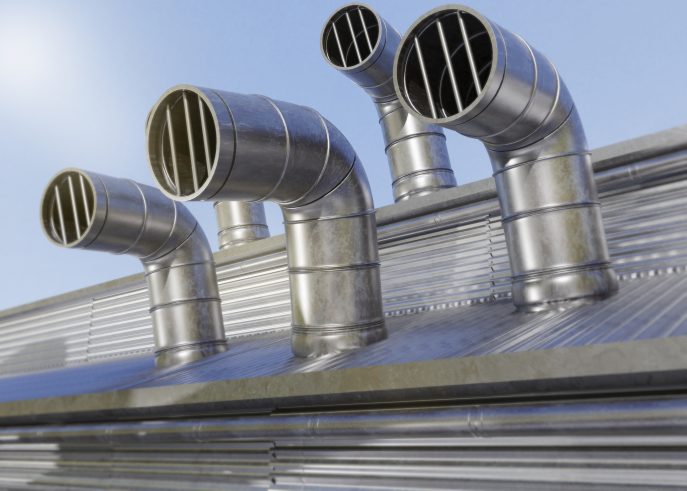
Industrial roof exhaust fans are installed on the roof of a building and pull air upward and out. They work with natural airflow principles, as hot air and fumes rise, making them effective in large and high-ceiling spaces.
These fans consist of a motor, fan wheel, housing, and weather-resistant base. When connected to ducting, they support systems such as a commercial kitchen extractor fan or full restaurant exhaust fan setup.
There are two main types. Centrifugal roof fans are designed to handle grease, smoke, and heavier air particles. These are commonly used with commercial kitchen exhaust hoods. Axial roof fans focus on moving large volumes of air quickly and are used in warehouses or industrial production areas.
Industrial exhaust fans for roof use are commonly found in manufacturing plants, large kitchens, and processing facilities where continuous ventilation is required.
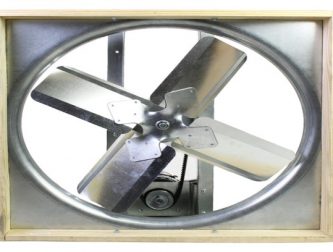
Wall-mounted fans are installed on interior or exterior walls and move air horizontally. Their structure is simpler, including a motor, blades, safety guard, and mounting frame.
Some models oscillate to cover a wider area, while others remain fixed and direct airflow to one location. This makes them suitable for targeted cooling or airflow in specific work zones.
Wall-mounted fans are used in workshops, storage areas, and small industrial rooms. They are also used as a secondary solution with a larger restaurant exhaust fan or roof system, when a full exhaust fan install is not practical.
The main benefit of industrial roof exhaust fans is their ability to manage large volumes of air. They are effective at removing heat, smoke, and fumes from big facilities.
They are good at supporting indoor air quality and function perfectly with commercial kitchen exhaust hoods and grease management systems. You can notice less strain on the cooling system and improve working conditions.
Their robust design also makes them suitable for long-term use in demanding environments.
Wall-mounted fans offer flexibility. They are cost-effective, easy to install, and suitable for smaller or divided spaces. Maintenance and replacement are straightforward.
They provide targeted airflow, which can improve comfort in specific areas without modifying the entire building. For facilities with moderate ventilation needs, wall-mounted fans can be a practical solution.
Roof-mounted systems come with higher installation costs and require roof modifications. Maintenance access can be challenging in poor weather conditions.
Wall-mounted fans have limited coverage. They are not ideal for removing heavy heat, smoke, or grease in environments that rely heavily on a kitchen ventilation system or continuous exhaust.
Initial costs are lower for wall-mounted fans. Purchase and installation are relatively simple. Roof systems require a larger upfront investment due to installation complexity.
In the long term, industrial exhaust fans for roof applications offer better value. They last longer and handle demanding conditions more effectively. Wall-mounted fans may incur higher replacement costs over time.
Conclusion
The choice between industrial roof exhaust fans and wall-mounted fans depends on the size of your space, the level of heat or fumes produced, and long-term operational needs. Large facilities and commercial kitchens benefit from roof-mounted systems, especially when paired with a commercial kitchen extractor fan or restaurant exhaust fan. Smaller or targeted areas may find wall-mounted fans sufficient. Selecting the right solution ensures better air quality, comfort, and efficiency.
If you are planning a new exhaust fan install or upgrading an existing system, Wired Air offers practical, tailored solutions. From industrial roof exhaust fans to complete kitchen ventilation system designs, our team focuses on performance and reliability.
Contact Wired Air today on 0429 612 624 to discuss your ventilation needs and find the right fit for your space.

If you have hired or are hiring electricians before, whether for a sma
Improving the air circulation in your house can ensure that every envi
 Optimized by Seraphinite Accelerator
